Facebook’s New Logo

Image Credit: Facebook promotional photo

Jun 30, 2015, Christophe Tauziet, a product designer at Facebook, shared a shot of the new Facebook logo.

So far feedback on the new logo from Facebook’s 1.44 billion or so users is sparse, and that’s for a few good reasons. Most importantly, the design doesn’t appear to have even rolled out yet — a visit to Facebook.com (logged out) reveals the original logo we’ve known and tolerated for about ten years.

All we currently have to go on is Tauziet’s snapshot of the logo printed on a rolled up t-shirt, which conceals many of the design’s subtleties, but there are some clear changes:

Overall, the design is far more rounded, and a whole heap more friendly. There’s slightly less weight, aided by slightly more contrast, which makes the logotype less aggressive. It is far less corporate, in the ironic manner in which many web-era corporate logos are less corporate.


The "F" logo hasn't been updated to all pages just yet, including the Brand Permissions page. However, it has been added as the picture to Facebook's Twitter account.

Other official pages have received logo refreshes in the past few weeks, from the security badge to the privacy icon. The redesigned logos feature Facebook's signature blue color as a background to create a more streamlined, uniformed look.


What do you think of the new logo and icons? Will you miss the light blue line? Comment Below.

Why Infographics Still Matter in Search Engine Optimization

While 90% of cases infographics are poorly designed and researched, it’s unfair to write off such a valuable media type. A good infographic empowers reader understanding by breaking down complex information into digestible, visual chunks.

In this article, I’m going to explain why high-quality infographics remain an important weapon in the inbound marketer’s arsenal.

1. Infographics are Shareable, Linkable and Evergreen Assets


According to Hubspot, 40% of people will respond better to visual information than text, while photos/images on Facebook get shared five times more than text.
The infographic has jumped on the visual bandwagon, exploding as a form of shareable content and guaranteeing marketers measurable results.
Infographics also provide evergreen content. A controversial news story or survey might gain you a spike of social shares if it reaches the ”right audience” at the ”right time”, but from my experience this type of PR is a lot more hit and miss. With an infographic, you have a permanent linkable asset that retains relevancy and will get shares months after it’s published on your website.

2. Infographic Research can be Recycled into a White Paper or Press Releases

recycle-content
This is where most people completely miss the boat with infographics. They’re not just about making stand-a-lone visual assets. A clever marketer will re-apply the same research and data for a white paper, press release or investigative piece. If your editors and content marketers have spent days undertaking research for an infographic then they should re-apply that knowledge elsewhere to create additional inbound marketing opportunities.

3. Infographics Enables Brands to Gain Traction and Links in Difficult, Complex Industries

One of my favorite things about infographics is that they can penetrate industries where the traditional barriers for content and guest posts is set very high.
For example, high frequency trading (HFT) is a technologically complex industry that revolves around microwave transmission cables, exchange internalization, microchips and more. There’s no way our team would’ve been able to write an article to a high enough standard in this industry.
However, when we launched a really simple infographic showing a time-line for the history of HFT, it was picked up and published by half a dozen reporters and bloggers in this market. In this example, our infographic gave us a way of cracking into the complex world of HFT that we otherwise wouldn’t have been able to do.

4. Earn Links form Outside your Industry

Following on from the above, infographics also allow sites in niche, difficult industries with little natural linkage (e.g. gambling) to earn links from other markets. This is because editors will often credit you for the infographic regardless of the contextual relevance or credibility of your site.
I developed an infographic on RightCasino.com that used the luck element in gambling as a springboard to examine the chances of arriving at any single piece of web content. This earned links from authority sites such as Cheezburger.com and Business2Community.com.

5. Help Build Editorial links in Guest Posts

The world of guest posting is changing and it’s becoming harder to acquire natural, editorially sanctioned links to your content. Webmasters are adopting stricter external linking policies. Infographics help provide an excuse to link back to your site whist providing value to the reader.
The strategy for promoting infographics via content marketing largely depends on the contact method. For example, on Twitter you need to keep messages short and simple – just ask for RT if someone has lots of followers. When you’re sending out press releases to journalists you don’t really need to personalize it since it’s all about the headline. If you’re reaching out to bloggers or looking to do a write-up however, you should personalize emails and say you’re happy to get one of your researchers to contribute an accompanying article with some additional ”unseen data”. This gives them an extra incentive to publish your work.
Never ask for a link, it should be naturally embedded into the content anyway. Given Google’s recent stance towards devaluing auto-embed links, it’s the editorial links in content that you’re after.

6. It’s Easier to Explain Complex Data, Facts and Figures through Visual Form

The human brain has a hard time processing large numbers and information. However, psychologyexperts have proven that visual aids have massive pedagogic and mnemonic value. Infographics condense important tables, charts and data into a single canvas. It’s more user-friendly to show the odds of winning the lottery on an infographic than publish a rambling page of charts, illustrations and tables. Information has to be digestible for it to go viral.

7. ”Stat-Jacking”: Journalists will often give you Link Credit for the Stats

This may be cheeky – but you’re not to blame. Many journalists will give you link credit for stats in your infographic even though the stats are from elsewhere (as noted in your references). Incidentally, the references in your infographic represent important linking leads.

8. Infographics don’t have to be Expensive

I know that 90% of infographics look rubbish; therefore I don’t want to extol the virtues of a one-hour infographic from fiverr. However, this doesn’t mean you need to fork out thousands on an infographic design agency either. For example, you can find plenty of high-quality freelance graphic designers from sites such as PeopleperHour.com and Microlance.com for as little as $500 if you’re willing to spend the time looking for them and organize your own research and briefs.

9. Infographics are Great Tools for News-jacking

News-jacking is the art of taking news events or stories and turning them into major marketing opportunities for your brand.
Infographics are good for news-jacking because they offer something to editors when they’re reporting on news stories. They’re particular useful for data release and analysis since they help convey figures more effectively. For example, imagine if Congress suddenly announced that the US had a trade deficit of $5 trillion. You could then use this data to create an infographic that shows what you could buy with this money e.g. $5 trillion equals ”50 private islands in the pacific” or ”a Ferrari for every citizen in the US”.
Another good news-jack example is CNBS’s infographic, which compared social chatter of Twitter’s IPO to Facebook’s IPO shortly after Twitter went public.

10. Infographics have Measurable Results and ROI

In Rand’s white-board Friday, he argued how on-page visual elements provide more value to marketers than infographics. The problem with his argument however is that they’re two separate things – visual elements are a form of content development; infographics are a form of PR and marketing.
The advantage of infographics is that they offer quick measurable results such as social shares, backlinks, citations and traffic. These results allow SEOs to create a comprehensive ROI report for their clients. It’s much harder on the other hand to measure the results of dozens of individual visual elements and justify the content spend.


I hope that you see the full potential of Infographics: a way to get quality backlinks to your site. If you enjoyed this article, Share your tips and tricks in the comments.

Create a winning SEO campaign with SEO PowerSuite

SEO PowerSuite is a comprehensive pack of 4 SEO tools, each dealing with a particular aspect of SEO. The package has all you need to get top search engine rankings and see your traffic and sales boost. Check out the step-by-step guide below to create an SEO campaign that's a smashing success.

1. Find your target keywords

Decide on the keywords you'll be building your SEO campaign around.
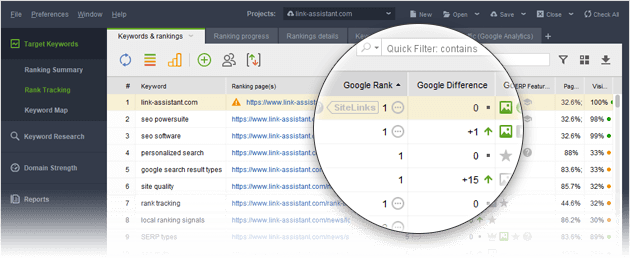
Step 1: Get keyword ideas. Run Rank Tracker and follow the Wizard's instructions to create your first project. Switch to the Keyword Research workspace, and press "Suggest" to have hundreds of great keyword ideas generated for you with the use of over a dozen keyword research methods.
Step 2: Pick keywords with most profit-generating potential. Look at your keywords' KEI (Keyword Efficiency Index) to choose the most profitable keywords.
The terms with a green KEI are frequently searched for and have pretty low competition. Simply put, these can bring you lots of visitors — while being comparatively easy to rank for.

2. Check your website's rankings

Run a ranking check to see where your website currently stands.
Step 1: Select your target search engines and run the check. Press  in Rank Tracker and choose your target search engines to see your website's current ranks for the selected keywords.
Step 2: Identify keywords you need to focus on. Take a look at your current ranks — you may be ranking well for some terms already. Spot keywords your website doesn't rank high for, and concentrate your SEO efforts on those.

3. Detect on-site issues and fix them

Run a site audit to reveal errors and warnings that are holding your rankings back.
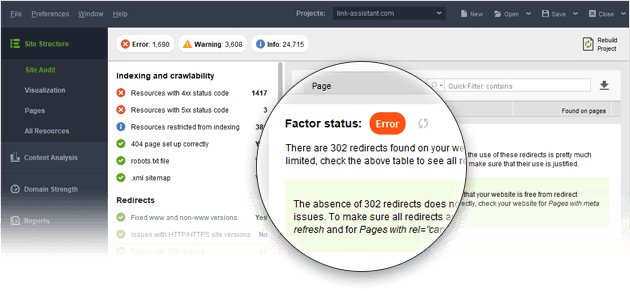
Step 1: Scan your website. Run WebSite Auditor and enter your website's URL to start the analysis.
Step 2: Find your site's weak spots. Take a close look at the factors with error and warningstatuses. Switch between Details and Recommendation to see problem pages and get tips.
Make sure you fix errors and deal with warnings accordingly to make your website search engine friendly.

4. Optimize your landing pages

Create relevant, keyword-rich content using specific optimization tips.
Step 1: Analyze your pages. Go to the Content Analysis module in WebSite Auditor, select the page you'll be optimizing, and enter your keywords. Let the software run a quick analysis of your page to get your page’s current optimization rate, details on keyword usage and other SEO stats.
Step 2: Follow optimization instructions. Pay attention to any factors with an Error or Warningstatus. Switch to the Competitors tab for details on how your top-ranking competitors are optimizing any given page element, and the Recommendation tab to get specific, keyword- and page-targeted advice on how to improve your page's optimization. Follow these tips to see your rankings (hence visits, hence sales, remember?) skyrocket.

5. Eliminate harmful links

Examine your backlink profile and get rid of the links that are dragging your rankings down.е
Step 1: Evaluate your backlink profile. Run SEO SpyGlass and enter your website's URL to collect your backlinks.
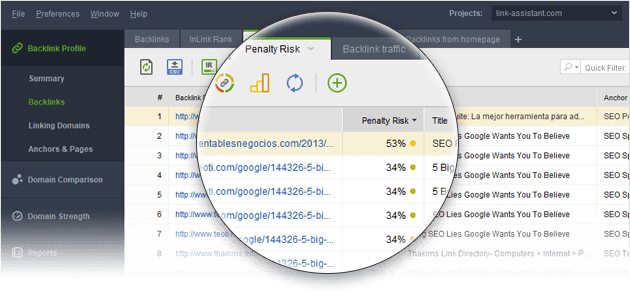
Go to the Link Penalty Risks tab, select your backlinks, and hit  to see if some of them may be doing your website more harm than good.
Take a closer look at links with a penalty risk over 40% and examine these pages to decide which of the links need to be removed.
Step 2: Get rid of bad links. If possible, reach out to webmasters of sites spammy links come from, asking them to take the links down. If there's a large number of harmful backlinks in your profile, or if outreach proves ineffective, you can tell Google to ignore these links by disavowing them.
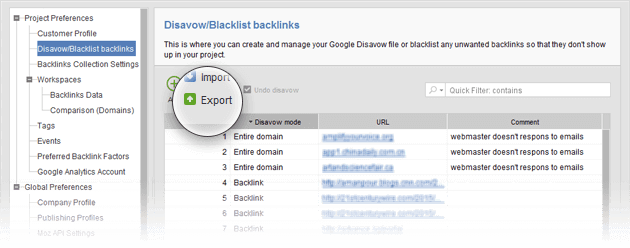
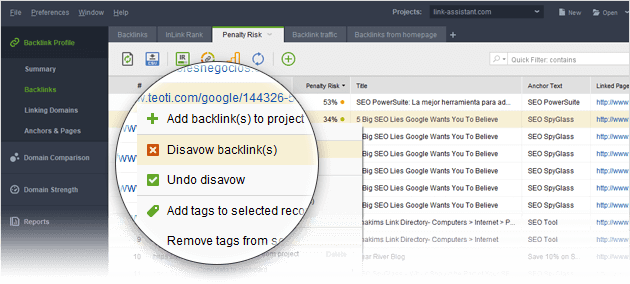
To generate a disavow file in SEO SpyGlass, select the links you want to disavow, right-click them, and hit Disavow backlinks. Go to Preferences -> Disavow/Blacklist Backlinks to review your disavow file, and hit Export to save it on your computer when it's ready.
Submit the file you created to Google Disavow Tool, and voila - Google will know which links to ingore when deciding on your website's authority.

6. Build quality links

Expand your link profile with relevant, high quality backlinks.
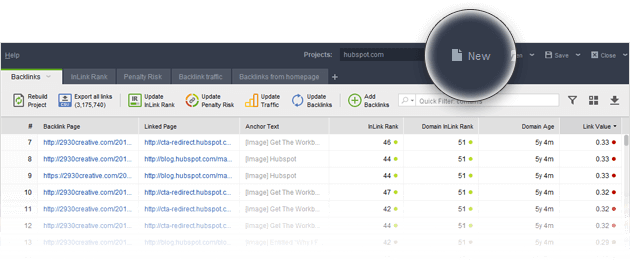
Step 1: Discover link prospects within competitors' backlink profiles. Create projects in SEO SpyGlass for your best ranking competitors to see where they got their backlinks from. In a competitor's project, hit  to analyze their backlinks' quality. Pay attention to backlink authority factors like Page and Domain PR (or Moz's PA/DA), Domain Age, Link Value, etc., and identify top link sources. Export your shortlisted links through File -> Export or by copying them to a spreadsheet.
Run LinkAssistant and create a project for your site. Use the File ->Import option to load the link sources you've exported from SEO SpyGlass.
Step 2: Find more potential link partners. To find even more link partners using advanced search methods, hit .
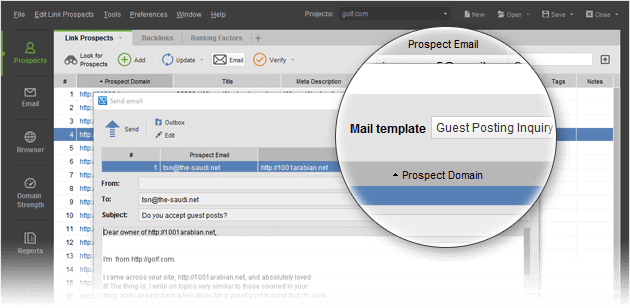
Step 3: Reach out. In your LinkAssistant project, click  to contact potential partners and inquire if there are link opportunities available, such as guest posts, listings in quality business directories, or others.

Create a winning SEO campaign with SEO PowerSuite:

  • Find your target keywords
  • Check current visibility in search engines
  • Detect on-site issues and fix them
  • Optimize your pages' content
  • Get rid of harmful links
  • Build new quality backlinks

The Philosophy Behind Link Building


Among Internet Marketer, there seems to have controversy when it comes to baclinks, link building strategies & it's importance. if you ask a group of online marketer, What is a backlink?, Why are backlinks So Useful?, How do search engines evaluate backlinks?, importance of backlinks in seo? link earning, etc you'll get different & vague answers from them.

To make you clear, in this post I'll write simple to understand definition of Philosophy Behind Link Building & to help you make sense of what's backlinks truly harmful for your website.


So, What is a Backlink?

What is backlinks

A backlink is a clickable piece of text or an image that links one website, webpage, or files to another. As an example here is a link to the Local SEO Consultant at this website, which is surrounded by the anchor text "Local SEO Consultant", So, we’ve got the answer of most important question out of the way.

Backlinks are also knows as Internal Links, Inbound Links & Outbound Links. Let’s move on to Why are backlinks So Important to the web in general as well as for SEO prospective.

Why are Backlinks So Important?

Without backlinks the world wide web (aka WWW) as we know it wouldn’t exist. Without backlinks, how would we ever browse the internet? Now I know you’re going to Say, well I could search in Google to find the results I want. That however is not really going to work because how could Google find and index all the webpages on the Internet without being able to search around from link to link?. And even google managed (Many of you believe, "Google can do anything!") to do it & how could you visit those webpages, if backlinks don't exist on google search index?

So, Backlinks are useful & also important, because it's the reference of the WWW. Without reference we’d still survive, but getting around would be pretty difficult, wouldn’t it?

For example, if a Local SEO Expert has a website about how to build healthy backlinks, and received a backlink from another website about backlinks building, then that would be more relevant in a search engine's assessment than say a link from a site about carpet cleaning. The more relevant the site is that is linking back to your website, the better the quality of the backlink.

How do Search Engines Evaluate Backlinks?

Search engines like Google, Yahoo! & Bing crawl the world wide web looking for new content to display to their searchers. They go from link to link, site to site and page to page finding content so they can show them when someone searches a query which each page is highly relevant for. These links could be on websites or blogs or document or social media sites. This is one of many reasons why backlinks is so important to SEO.

The number of backlinks is an indication of the popularity or importance of the particular website. Backlinks are important for SEO, because some search engines, especially Google, give more value to websites that have a good number of healthy quality backlinks, and consider those websites more relevant than others in their results pages for a user search query.

In Google's eye, A backlink considered to be a positive 'vote' for the receiving webpage from another granting webpage.


Why are Backlinks So Important in SEO?

In deciding how search engines rank webpages, they want to give their user the most relevant & useful result which satisfies the users search query. If you type ‘local seo services’ into Google and you get results for carpet cleaning and janitorial service companies, what are you going to do? You’re going to search in another search engine such as Bing or Yahoo!, and Google may have lost you as a user.

Google is the market leader in search and they have a 63.8% market share in the U.S according to comScore Releases February 2016 U.S. Desktop Search Engine Rankings. They’ve achieved this by giving us the best results when we search for things compared to their competitors. Therefore the key is giving the most relevant set of results for any of the billions of possible things somebody could type into the search box.

Not only are backlinks the reference that search engines use to find webpages but backlinks are one of the major signals that search engines use to decide how relevant and authoritative a particular page is. The links which point at individual pages from other web pages around the internet really help search engines to understand more about pages and how to best arrange them to keep their users happy. You’d be surprised. There’s a lot of information that can be collected from a backlinks and they gather the maximum information possible!

When the search engines calculate the relevance of a site to a user search query (aka keyword), they consider the number of quality inbound links to that site. So we should not be satisfied with merely getting inbound links & it's quantity, it is the quality of the inbound link that matters most. A search engine considers the content of the sites to determine the quality of a link. When inbound links to your site come from other sites, and those sites have content related to your site, these inbound links are considered more relevant to your site. If inbound links are found on sites with unrelated content, they are considered less relevant. The higher the relevance of inbound links, the greater their quality.

For example, If you are an Carpet Cleaner in Phoenix, Arizona and somebody searches for ‘carpet cleaner phoenix’ you want to be on page 1, right? Page 1 normally only has 10 results and you can bet that there are far more than 10 cleaners competing for that page 1 spot. Whilst there are a huge number of factors in Google’s algorithm and backlinks certainly aren’t the be all and end all, backlinks are one of the strongest factors currently used. In your case, Local SEO is highly important for your local businesses, and of course we do offer local SEO services.

Another reason you may want to achieve backlinks is to allure more visitors to come to your website. You can't build a website, and then expect that people will find your website without showing user the way. You will probably have to get the word out there about your site. One way business owner & webmaster got the word out used to be through backlinking. Let's talk about, how can we help you to build backlinks.

How Can We Help You to Build Backlinks?

Backlinks Building is what we usually do. As discussed, backlinks are not the only important search engine ranking factor to be considered but in any good SEO campaign you will have to build high quality backlinks to your website to help to show search engines that your site is relevant for the keywords agreed upon at the keyword research stage of the SEO Strategy. Building backlinks is known as off site optimization.

Honestly, it’s not easy to get natural authority backlinks (Great Healthy Backlinks Require a Great Amount of Time, Work & Content), after all why would another webmasters or websites owner link back to your site. Our job with the SEO link building campaign is to help you to create mirthful link worthy content for your website and then to use various plans and methods to inspire relevant webmasters or websites owner to link back to your website & content.

The days are long gone, when low-quality reciprocal links, links from link-farms, & paid links worked for search engine organic ranking. Instead we focus our all attention to creating high quality content. We create a serious content marketing strategy & execute them accordingly. We’ll be able to establish your business website as an authority site within your given niche or industry.


What's About Reciprocal Links, Link farms, and Paid Links?

There is much discussion about reciprocal links, link farms, paid links & It's Importance last few years. In the Google Jagger Update at October 2005, In this algorithm changes, Google released a series of updates, mostly targeted at low-quality links, including reciprocal links, link farms, and paid links. Reciprocal links were one of the targets of Google's Jagger update & Google not valuing reciprocal link exchange since then.

Many webmasters had agreed upon reciprocal link exchanges & paid links, in order to boost their website's rankings with the sheer number of inbound links. In a link exchange, one webmaster or website owner places a link on his website that points to another webmasters or owners website, and vice versa. Many of these links were simply not relevant, and were just discounted by google jagger algorithm update. So while the irrelevant backlink was ignored, the outbound links still got counted, diluting the relevancy score of many websites. This caused a great many websites to drop off the Google Organic Ranking.

In a Paid Links, one webmaster or website owner places a link on his website that points to another webmasters or owners website for money. This links too act as reciprocal link & but called one way reciprocal link.

We must be carefully dealt with these kinds of link. Google not only check the popularity of the sites being linked to, but also how trustworthy a site is that you link to from your own website. This will mean that you could get into trouble with the search engine just for linking to a bad website. Please read more about google's Link schemes.

How to get rid of the harmful links Pointing to your website?

  • Ask webmasters to remove the links.
  • Submit the harmful links to Google disavow tool.
  • Make sure to regularly re-check your links.
  • Contact Us & We"ll Help you remove harmful links.


What's Link Earning?

Link Earning is the process of creating high quality content that other webmaster, website owner and bloggers cannot fail to link to your website content. And hey, this give you more power if you’re a recognized brand that can build your link portfolio this way. This is indubitably the ideal scenario for any website owner. But if you’re NOT recognized as a brand, however, this version of link earning Technics is highly unrealistic expectation for you.

Because Search Engine Algorithms are highly dependent on quality & authoritative backlinks, you’re not going to rank if you don’t have high enough quality backlinks.

And guess what? If you don’t rank high on search engine organic result, the primary reference that would allow people to find your website useful and amazing, is besieged for all intents and purposes.

So you can’t be found in search engine's organic search unless you have enough backlinks, and you can’t realistically “earn” links unless people are finding your site.

What If I Use Backlink Building Tool?

I wouldn't recommend you to use a backlink building software, it has to be "manual". If you use a link building software to build Automated links, Google will eventually find out and your website could be penalized.

Here are some Automated Link Building Techniques that are definitely going to caught by Google Algorithm:

  • Spun Content Submission.
  • Blog & Forum Commenting.
  • Forum Profile & Comment Link.
  • Low Quality Directory Submission.
  • Private Blog Networks.

Be Careful Of Outgoing Links: I’m going to keep this part simple, here are some quick guides for outgoing links:

  • Bad Neighbourhoods (spam, warez etc sites)
  • Moderate or Remove any obvious spam from user generated content and apply nofollow to any outgoing links.
  • Don’t link to low quality sites/content.
  • If you are selling links, Add the nofollow attribute to the links.
  • Add the nofollow attribute to any affiliate links.
  • Don’t hide outbound links.
  • Periodically review and clean up broken outbound links.

Need High Quality Authority Link Building? Contact to one of our Link Building Specialists today to know more on how backlinks can help improve your website organic ranking.

How Do I Make a Begin Then?

Contact Us
Sylvester Stallone & Caitriona Balfe in Escape Plan Movie (2013)

Have a good read of the pages and posts of this site. We try to straightforward SEO as much as we can at here, and there is some good guidance that we write regularly. We also emphasize the importance of Good SEO Campaign & Mobile Marketing and if you are looking for Local SEO Services & Citation Building Service, we can help. Once you’ve decided what services you need from us, just fill out our contact form and we’ll get right back to you. We’d love to talk to you about your business and how we can help to take it forward online, and quite simply, make you more money.

Don’t worry, Our Local SEO Services & Citation Building Pricing is not expensive and we can talk through the options for you. We offer Guaranteed Local SEO and if you want instant traffic through PPC we can help you with Adwords Campaign Management too. We’re confident that you will have a huge return on your investment from our service. Contact Us Today!
.

How to Run Content Marketing With Success in 2015

To design an excellent content strategy, the most important thing (and which very few do), without a doubt, is to start by establishing “where we are headed”. In other words, our goals.
I have been working specifically with content marketing for the past 10 years and if there is something we have learned during this time, is that the difference between those that succeed and those that fail is NOT based on the quantity of resources they are able to invest (money/budget). It is in the clarity in which they define “why” they want to engage in content marketing.
In this article, we would like to share 3 objectives that, in our opinion, are essential and also universal, and can be used by any company in any industry. As an example, we’ll take the case of Boosted, a battery-powered skateboards manufacturer.

First Objective: Product Information

The first and perhaps the most intuitive and familiar goal of a content strategy, is to make your product known. You need to allow potential customers to obtain a greater knowledge of your products. Everything from: “How is it built?,” “How is it used?,” to: “Where can I buy it?”.
For this first objective, content such as “The differences between Boosted’s 3 models,”  “Advantages of using Boosted to commute to work,” and “Boosted’s policies of use and returns” are some of the most common examples.
Also, for SEO, at this first point you will be covering terminology from the brand name itself “Boosted”, to technical variations like “advantages of Boosted,” “parts for building a Boosted,” “requirements for riding a Boosted in public,” etc.

Second Objective: Mark the Problem

All great companies are successful because, at the end of the day, they are solving real, concrete problems of their potential customers, who pay to use their products. The second goal of your content strategy is to focus on the problem your product solves.
This gives us a wider range for creating content. For Boosted, that would mean: “Alternatives to using a car to commute to work,” “The 3 most ecological methods of transport that exist today,” or even “Why using a skateboard is better for our health than a bike.”
The audience reached with this type of content goes further than potential clients, and so, if we compare the conversion rate for this objective with the first we will find a significant decrease. However, by utilizing this method you will have the possibility of reaching people of influence, referrals, the media, and possible boosters for our company as well.
Concerning SEO, the advantage lies in targeting keywords that are broader and go beyond our product itself, specifically with information searches performed by Google users regarding the problem that we are solving, such as: “means of transportation that use batteries for getting around the city.”

Third Objective: Empower your Vision

The final objective is focused on the possibility of “viral” exponential growth in order to build brand awareness. This also means reaching an audience that is beyond our potential direct customers.
An example of this would be the creation of video content about: “Can a battery-powered skateboard move a car?”
The idea behind this last objective is to get the most out of social networks through the virality of what your product can obtain when used in exceptional/extreme situations and moments.
Although for this type of content you will probably see the lowest conversion rate from all the three options mentioned in this article, this is definitely an excellent way to reach people who will later have an influence on potential customers.
In regards to SEO this can also be greatly beneficial. Viral content attracts links, thus increasing your brand’s recognition when it comes to Google and all the other search engines merely by being mentioned.

The single mechanism for implementation

Knowing the “why” behind your content marketing strategy and your goals, it is time to get to work.
Here are my 4 implementation tips for those who wish to start working on their strategy today:
1. Exclusive to experts: What I want to say with this is that all your content needs to be developed by experts. Under no circumstances should your information be poor. There is already too much content in the web that is of poor quality, adding to that accomplishes nothing.
For our blog for example, those who built the product with their own hands, the creators, are the only ones who create content. If they do not have the time to do it, the best thing we found to be is to hire a writer who can observe what they do and what they want to communicate and share through a note/article.
2. Focused on the customers: You should never take for granted your customers. Every question, doubt, concern, inquiry, and suggestion that they have, represents an ideal launching pad for the creation of valuable content. If, for example, a customer wants to know who created the product and where the idea came from, then it is the ideal moment to create an interview with the founders and make known the values, mission, and vision of the company.
This is the best way to create evangelizers for your project that will help you grow more than you imagined in the long run.
3. Do not concentrate on text only: Even though search engines are mainly organized to index text, you should remember that the second largest search engine in the world is YouTube. Thus, creating videos and other formats for content becomes fundamental.
4. The key is patience: As I mentioned, content quality is of utmost importance. However, time is as well. For content marketing, time plays a determining role. It is not the same as hiring a TV ad or an announcement in Google Adwords, which take effect from one day to the next. With content we are talking about seeing results on an average of weeks or even months.
At that brings us to the great overlooked opportunity that content marketing brings – results that do not disappear from one day to the next (a paid announcement, once it is no longer paid, ceases to exist). Effective content will last over time and will bring dividends even a year after being developed.
Content marketing is something organic that needs our patience and dedication.